The Comfort Zone Model is based on the idea that when people are immersed in an experience they perceive as stressful, they are presented with an opportunity to overcome it and grow as an individual. (Panicucci.J 2007) (See image)
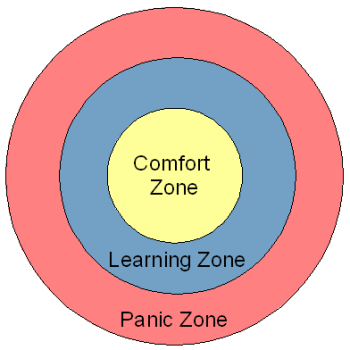
However, (Brown 2008) suggests this model could be used as a metaphor for post-activity discussion rather than a model for adventure programming due to weak support in educational literature. He concentrates on theories of cognitive development by (Piaget.J, 1977,1980) and cognitive dissonance by (Festinger,1957). He raises the concern that we as adventure educators have only loosely grasped these theories and their applicability in an adventure education setting. How do we decide when one’s comfort zone is being stressed appropriately but keeping them from the panic zone?
This assumes that the adventure educator has the competence to assess each participant’s needs and perceived level of risk to ensure that learning will occur (Estrellas, 1996).
In practice, I have seen participants and I myself have engaged in activities with a sense of apprehension and mild stress and on many occasions this has been overcome by critical thinking, reasoning, encouragement and reassurance.
However, many of the participants I am increasingly working with have experience with anxiety, depression, addiction and behavioral difficulties. Perhaps, as (Davis-Berman and Berman 2002.P.30) suggest, that ‘intentionally heightening the perception of risk in outdoor programmes, we may be pushing participants beyond their ability to cope effectively and may be creating unacceptably high levels of anxiety in participants’.
In order to provide meaningful learning experiences for our participants, it may be time to reevaluate our collective attachment to the comfort zone model?
Additional Reading:
Leberman,S and Martin, A. (2003). Does pushing comfort zones produce peak learning experiences? Australian journal of Outdoor Education, 7 (1),10-19
References:
Panicucci,J, 2007. Cornerstones of adventure education. In D,Prouty, J.Panicucci and R.Collinson (Eds) Adventure Education: Theory and applications (pp.33-48). Champaign,IL:Human Kinetics.
Estrellas, A. (1996). The eustress paradigm: A strategy for decreasing stress in wilderness adventure programming. In K. Warren (Ed.), Womens voices in experiential education (pp.32-44). Dubuque, IA: Kendall Hunt
Berman, D., & Davis-Berman, J. (2005). Positive psychology and outdoor recreation. Journal of Experiential Education, 28(1), 17-424
Piaget,J (1977) The development of thought (A.Roisin, Trans). New York, Viking Press.
Piaget,J (1980) Adaptation and intelligence (G.Eames, Trans). Chicago: University of Chicago Press.

A very well presented discussion. Strong use of varying theories and concepts with good application to practice. With a little more flexibility around word count you can develop one or two of these ideas and make a more critical analyse of theory to practice link. Use of images can benefit blog also.
ReplyDeleteWell done.