Tuesday, 12 December 2017

Transfer of Learning Through Outdoor Education

One of the biggest challenges we face in education both inside and outside the classroom, is the extent to which what is learnt in one context can be transferred to another (Brown, M. 2010)

Transfer has been described as one of the most critical features of adventure programming (Priest, S., Gass, M.A. 2005) and the true value or effectiveness of an adventure programme lies in how the learning experienced during the activity will serve the learner in the future (Gass, M.A. 1999). As adventure educators, how much of this are we aiming for in our own workplace? Sure, we might be aware of the concept of transfer but are we throwing the term around to justify what we do?  Or are we designing our outdoor education programmes with this outcome in mind, and if so, how much have looked into the research behind the construct?

To understand this further, let’s look at what transfer is and perhaps consider its continued use as an outcome…

To put it simply, transfer is the quest to see if some knowledge or skill learned in one context will be repeated or utilised in another context (Detterman, D.,1993). In the outdoor environment, Priest and Gass (1997) define transfer as the integration of learning from the adventure program into the participant’s real life.                                                            

In adventure education settings, there are three theories concerning transfer of learning from one environment to another; Specific, Non Specific and Metaphoric Transfer. (See Fig.1) (Gass, M. 1999)


A participant may have learnt the skill of belaying a rock climber on day one, on day two they are learning to abseil, the participant makes the association between the similar use of the belay device for both situations, this is specific transfer shown in Fig.1: 1A-1B.

In Fig.1 2A-2B The non-specific transfer occurs when a participant takes the common principles they have learned from one situation, generalises them, then applies them to a new situation for example, a participant may learn the value of building a trusting relationship through a team task then transfers this learning to a similar situation when making friends in a school environment.
The third transfer theory is metaphoric transfer, depicted in Fig.1 3A-3B, similar to non-specific transfer in that the participant learns the principles from one situation, generalises them, then applies it to a new situation, however the new situation differs structurally but is similar metaphorically.  
For example, two participants learn to paddle a canoe over a weekend course, they learn that to move the canoe forward efficiently, each person must paddle evenly and smoothly, because if they don’t, the canoe journey becomes jerky and the progress slows down.
One of the participants goes back to work on Monday and ‘transfers’ this by generalising the principle of working together efficiently to maintain steady progress to reach the target they have for their project.

These theories are applicable, it’s easy to see how we can link them to adventure education and depending on the approach to learning the facilitator takes through briefs/debriefs, reflection, use of metaphors or simply ‘letting the mountains speak for themselves’ the learner may transfer the skills and knowledge….or…..they may not. After all, why is it that a participant displays teamwork and care for others during a camp experience, they may not do this back at school? (Beames, S., Brown, M. 2016).
Research into whether transfer occurs has proven hard to define, difficult to investigate, and perplexingly controversial (Packer, M. 2001 p. 493). There are a number of problems with the research into transfer with little empirical evidence to support the concept (Detterman, D., 1993)

Despite the low reliability and validity of some of the studies that have been done, there are some situations that transfer can occur according to Perkins,D &  Salomon, G. (1989). In ideal conditions (a laboratory classroom) transfer has been successful when there was instruction or intervention from the facilitator to show the learner the resemblance of the problems and leading the learner to make the connection.
In adventure education, this could be considered as ‘speaking for the experience’ or ‘front loading’ the experience. Detterman (1993) made the remark that guiding or telling subjects to use a principle or directing them to think about a previous exercise is not truly transfer but merely following instructions.

In my own workplace, I have found the concept of transfer difficult to apply. Yes, I have witnessed specific transfer from one adventure activity to another however non-specific and even more so metaphoric transfer is much harder to accomplish considering the context, relevance and relationship between the individual, their conscious state of mind at the time and the activity itself.
What we could be asking ourselves with regard to transfer of learning is how can we create authentic adventure education programmes that allow the participant to learn in the ‘real world’ and have relevance to day to day life rather than framing them metaphorically?

I liken learning to Beames & Brown (2016) ‘Learning is a messy affair, there is not a linear relationship between what might be experienced, the behaviours that one might display and long term learning’.


And furthermore, the challenge before us is to better understand the relationship between what is taught during adventure education programmes and the capabilities participants currently have and should develop in their own (non-adventure education) lives so as to create learning experiences that are authentic and meaningful (Anderson, Greeno, Reder, & Simon, 2000).


Recommended reading: Brown, M. (2010). Transfer: Outdoor Adventure Educations Achilles Heel? Changing participation as a viable option. Australian Journal of Outdoor Education, 14 (1) 13-22. To further question whether transfer within outdoor adventure education should continue as an intended outcome.

References

Anderson, J., Greeno, J., Reder, L., & Simon, H. (2000). Perspectives on learning, thinking, and activity. Educational Researcher, 29(4), 11-13.

Beames, S., Brown, M., (2016) Adventurous Learning, A pedagogy for a changing world. Routledge: New York.

Brown, M. (2010). Transfer: Outdoor Adventure Educations Achilles Heel? Changing participation as a viable option. Australian Journal of Outdoor Education, 14 (1) 13-22

Detterman, D. (1993). The case for the prosecution: Transfer as an epiphenomenon. In D. Detterman & R. Sternberg (Eds.), Transfer on trial: Intelligence, cognition, and instruction (pp. 1-24). Norwood, NJ: Ablex

Gass, M. (1999). Transfer of learning in adventure programming. In Adventure Programming (Miles, J. & Priest, S.). State College, PA: Venture Publishing Inc.


Packer, M. (2001). The problem of transfer, and the sociocultural critique of schooling. The Journal of Learning Sciences, 10(4), 493-514.

Perkins, D., & Salomon, G. (1989). Are cognitive skills context-bound? Educational Researcher, 18(1), 16-25.

Priest, S. & Gass, M. (1997). Effective Leadership in Adventure Programming. Champaign, IL: Human Kinetics.


Priest, S., Gass, M.A. (2005) Effective Leadership in Adventure Programming (2nd Ed) Champaign, IL: Human Kinetics

Tuesday, 28 November 2017

Concept and Theories of Self Esteem

Self Esteem,  A vital human need for healthy development, seen here in Maslow's hierarchy of needs pyramid. Maslow,A.H  (1943) initially stated that individuals must satisfy lower level deficit needs before progressing on to meet higher level growth needs.


Maslow divided the self esteem tier into two categories:
1) Esteem for yourself (How you see yourself: beliefs, self respect, achievement, independence) 2) Esteem from others (How others to see you: respect, status).
Interestingly, Maslow indicated that the need for respect or reputation is most important for children and adolescents and precedes real self-esteem or dignity. McLeod, S. A. (2017)

Although I agree that self esteem is a vital need for healthy human development, I question the tier in which self esteem is on. Maslow studied people he deemed to be ‘self actualized’ from a sample of highly educated, successful individuals, not considering humanity in general. McLeod, S. A. (2017)
Low self esteem has been linked with depression and anxiety Mruk, C. J. (2013) the symptoms may include: Loss of interest or hobbies or activities, including sex, low appetite, overeating, feelings of worthlessness and helplessness. (Anxiety and Depression Association of America, 2017) How can one move up the hierarchy when self esteem levels affect the ability to achieve the lower two levels?
This would argue that the hierarchy of needs could be rearranged or at least conceptualised as fluid, that we could be striving to fulfil multiple needs as they fluctuate throughout our lifetime.

We now know that self esteem is important, but how do you develop self esteem? Or more importantly for outdoor educators, how do we facilitate the development of self esteem in others?

Bunyan, P. (2005) Includes a model of self esteem by William James (1980) that provides an understanding of how self esteem might be enhanced:
Self Esteem = Success
Pretensions


Fig.1
The model suggests that self esteem is the result of the dissonance or lack of agreement between achievements and aspirations.
The smaller or acceptable difference between what one aspires to and actually achieves, the higher their self esteem will be.
Therefore, if one sets realistic and achievable goals suitable for their ability it is likely their self esteem will improve.
This provides an example on where and how outdoor educators can work with participants on improving self esteem. By facilitating the steps in achieving an individual's goal,(Fig.1 Harley street psychologist 2015) we could potentially provide a ‘self esteem moment’
Self esteem moments, are two types of experiences:
1) A situation capable of generating success or failure in areas of life that are important to a given person. 2)  Experiences that involve being accepted or being rejected by others, both of which seem to relate to one’s sense of worth as a person. Mruk, C. J. (2013) This is explained in further detail below.

With reference to Maslow’s earlier statement on young people’s priority of need for respect and reputation, and the results of research conducted by Rosenberg (1965) that persons deemed ‘valued’ to the individual (friends, peers etc) or those thought to have similar ‘expertise’ had effect on the growth and threat to one’s self esteem. We need to be mindful of this when programming adventurous activities for peer groups.

Perhaps we should not be claiming to improve self esteem but offer ‘building blocks of self esteem’ or ‘self esteem moments’ This could also be applied to the more recent ‘Hierarchical model of Self Esteem’ Fox (1990)
This model represents entire global self esteem at the apex that is successively divided into categories that influence self esteem depending on the value of importance one places on these lower categories. It is unlikely that we can influence an individual's global self esteem, however we can potentially facilitate the enhancement of self esteem in the lower domains.


For example, while facilitating an abseiling session with a group of youths, it is often easy to notice ‘friendly competition’ (person’s of value). If one sees the person/s of value complete the task then they themselves do not, this essentially could affect their self esteem in the social and physical domains. Keeping in mind William James (1980) model for building self esteem to set a realistic and achievable goal in order to facilitate a ‘self esteem moment’ Mruk, C. J. (2013) We need to be looking at creating an environment that is suitable for facilitating this, perhaps by modifying the task or breaking it down into more digestible and appropriate goals.
Bunyan, P. (2005) suggests that as adventure educators we should be mindful when handling participants failures and successes. We should be proactive in helping individuals associate success internally to have the greatest benefit and to refer failure externally in order reduce negative impact on self esteem.
If growth in self esteem is an intended outcome of our adventure programmes, facilitators must consider the demographic characteristics of the group they are engaging with,
greater their understanding of how self esteem is built and be mindful of the threats to mitigate against them.


Further reading:
Mruk, C. J. (2013). Self-esteem and positive psychology. New York, NY: Springer Publishing Company.

Dack, C.M. & Ward, W.C. (2009) The Life Effectiveness of Wilderness Adventure Leaders, Association of Outdoor Recreation & Education Conference Proceedings, p.28-31


References
Bunyan, P. (2005). Towards the Measurement of Social Self-Esteem in the Adventure Environment. Ph. D. University of Southampton.

Confidence and self esteem counseling, (Harley street psychologist)(2015) Available:http://www.harleystreet-psychologist.co.uk/confidence-self-esteem-counselling/ Accessed:24 November 2017

McLeod, S. A. (2017). Maslow's hierarchy of needs. Available: www.simplypsychology.org/maslow.html Accessed: 24 November 2017

Mruk, C. J. (2013). Self-esteem and positive psychology. New York, NY: Springer Publishing Company.

Symptoms (Anxiety and Depression Association of America), (2017) Available at: https://adaa.org/understanding-anxiety/depression/symptoms. Accessed: 23 November 2017

Warren, M. (2013) Self Esteem-Principles of learning and teaching Available: https://michellekellywarren.wordpress.com Accessed 24 November 2017

Maslow, A. H. (1943). A Theory of Human Motivation . Psychological Review, 50(4), 370-96

Maslow, A. H. (1987). Motivation and Personality (3rd ed.). Delhi, India: Pearson Education.

Tuesday, 14 November 2017

Experiential Education….A Philosophy Worth Exploring.

Dewey (1997), 'The Modern Father Of Experiential Education' believed that learning needed real, guided experiences that will contribute to our everyday lives and as educators, we must first understand the nature of human experience.


Experiential education considers knowledge as a process of discovery in which practice develops into theory. (see fig 1,Reynaldo Flores. 2003) The educator facilitates learning by creating an environment for the student to explore and reflect upon in order to increase knowledge. Allison (pg18) depicts a traditional approach to education where knowledge is factual (right or wrong) and is based on memorising theory that guides practice (see fig 2, Project Based Learning. 2017) These are different approaches yet both are relevant in outdoor education.


Fig 1

Fig 2


For the experiential approach, Allison (pg 27) suggests that the role of the facilitator, student and the curriculum can be conceptualised as dynamic and involves issues around trust and risk that affect learning. We cannot jump from a didactic to experiential approach without first considering the social, physical and emotional aspects of the student learning. Trust, risk and learning are intertwined in this approach. To let the experience be the teacher, a facilitator must foster trust, create an environment where learners can take risks, and then reflect on the experience.


When working with students coming from ‘traditional education’ I have observed an interesting phenomenon in that they appeared to be ‘conditioned’ to a more didactic approach. When the option was presented to explore, question and reflect, there was often a pause. This may have been the student confronting a new style of learning. However it may have been situational anxieties (e.g. peer pressure) that caused the hesitation.


While experiential education offers a more dynamic educational philosophy, it is our responsibility to acknowledge the risks it brings and create a space for creativity and learning while keeping physical and emotional risks at bay.


Further reading:
Chapman,S,  Mcphee,P, Proudman,B. (1992). What is Experiential Education?. The Journal of Experiential Education, 15 (2), 16-23.


References:
Allison, P. (Unknown). Key Principles: Trust, Risk and Learning. Part 1 History and Philosophy, Ch 2, 17-29.


Dewey, J. (1997) Experience And Education: The 60th Anniversary Edition. Kappa Delta, Indiana


James Neill. 2006. Experiential Learning & Experiential Education Philosophy, theory, practice & resources. [ONLINE] Available at: http://www.wilderdom.com/experiential/. [Accessed 31 October 2017]


Project Based Learning. 2017. Project Based Learning. [ONLINE] Available at: https://sites.google.com/site/projectbasedlearningk5/high-frequency-sites. [Accessed 14 November 2017].

Reynaldo Flores. 2003. LEARNING STYLES THEORIES PART 3. [ONLINE] Available at: https://reynaldojrflores.wordpress.com/2013/06/08/module-2-learning-styles-theories-part-3/. [Accessed 14 November 2017].

Tuesday, 24 October 2017

The Comfort Zone: Model or Metaphor?

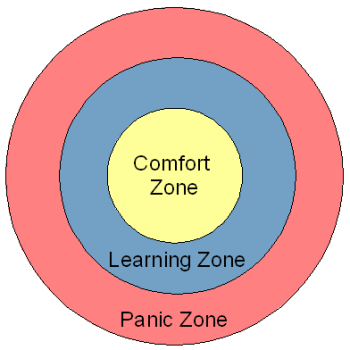
The Comfort Zone Model is based on the idea that when people are immersed in an experience they perceive as stressful, they are presented with an opportunity to overcome it and grow as an individual. (Panicucci.J 2007) (See image)


However, (Brown 2008) suggests this model could be used as a metaphor for post-activity discussion rather than a model for adventure programming due to weak support in educational literature. He concentrates on theories of cognitive development by (Piaget.J, 1977,1980)  and cognitive dissonance by (Festinger,1957). He raises the concern that we as adventure educators have only loosely grasped these theories and their applicability in an adventure education setting. How do we decide when one’s comfort zone is being stressed appropriately but keeping them from the panic zone?
This assumes that the adventure educator has the competence to assess each participant’s needs and perceived level of risk to ensure that learning will occur (Estrellas, 1996).
In practice, I have seen participants and I myself have engaged in activities with a sense of apprehension and mild stress and on many occasions this has been overcome by critical thinking, reasoning, encouragement and reassurance.
However, many of the participants I am increasingly working with have experience with anxiety, depression, addiction and behavioral difficulties. Perhaps, as (Davis-Berman and Berman 2002.P.30) suggest, that ‘intentionally heightening the perception of risk in outdoor programmes, we may be pushing participants beyond their ability to cope effectively and may be creating unacceptably high levels of anxiety in participants’.
In order to provide meaningful learning experiences for our participants, it may be time to reevaluate our collective attachment to the comfort zone model?

Additional Reading:
Leberman,S and Martin, A. (2003). Does pushing comfort zones produce peak learning experiences? Australian journal of Outdoor Education, 7 (1),10-19


References:


Panicucci,J, 2007. Cornerstones of adventure education. In D,Prouty, J.Panicucci and R.Collinson (Eds) Adventure Education: Theory and applications (pp.33-48). Champaign,IL:Human Kinetics.


Estrellas, A. (1996). The eustress paradigm: A strategy for decreasing stress in wilderness adventure programming. In K. Warren (Ed.), Womens voices in experiential education (pp.32-44). Dubuque, IA: Kendall Hunt


Berman, D., & Davis-Berman, J. (2005). Positive psychology and outdoor recreation. Journal of Experiential Education, 28(1), 17-424


Piaget,J (1977) The development of thought (A.Roisin, Trans). New York, Viking Press.

Piaget,J (1980) Adaptation and intelligence (G.Eames, Trans). Chicago: University of Chicago Press.